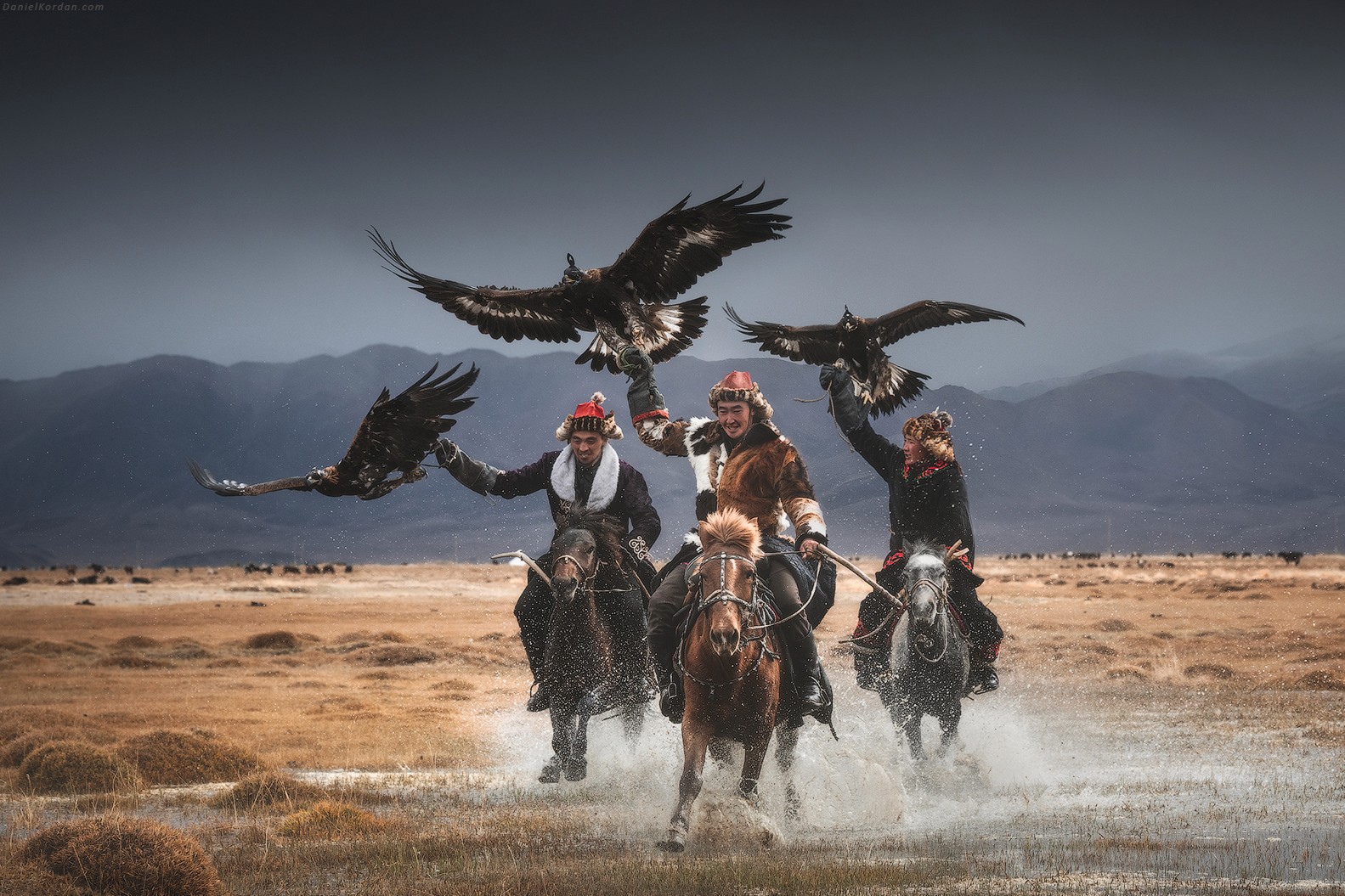
Not a festival performance. Not a photograph opportunity. The real thing.
Introduction
Before I tell you what it's actually like, let me tell you what it isn't.
It isn't a show. It isn't staged for visitors. And the eagle hunter isn't a character in traditional costume waiting for your camera. He's the head of a household with animals to feed, a family to support, and a bird that has been his working partner for years. When you sit with him, you are a guest in his life — not an audience.
That distinction matters. It changes everything about the experience.
The Man Behind the Eagle
Kazakh eagle hunters in western Mongolia are, in most respects, ordinary men. They wake up early. They worry about their livestock. They drink tea and talk about the weather. They have children who argue and parents who are getting old.
The eagle is not a hobby or a tradition performed for cultural preservation. It is a tool — a living one — that the hunter has raised, trained, and bonded with over years. And the relationship between them is something I've watched many times and still find difficult to fully describe.
It isn't ownership. It's closer to partnership — the kind that forms between two beings when each one knows the other needs them. The eagle knows its hunter's voice, his movements, the particular way he holds his arm. The hunter knows his eagle's moods, its hunger, the subtle shift in its posture that tells him something is wrong.
When you watch them together, you're watching something that took years to build.
The Eagle Up Close
Most people arrive expecting something majestic and distant. What they find is something far more unsettling and alive.
A golden eagle at rest on its hunter's arm is enormous — a wingspan of up to two meters, talons capable of exerting around 50 to 100 kilograms of gripping force, and eyes that track movement with an accuracy no human can match. Standing near one, you understand immediately that this is not a tame animal. It has been trained. That is different.
What stays with people — what I've watched catch visitors completely off guard — is the moment the eagle is released and called back. It drops from the hunter's arm, opens its wings, and rises. Then, from a distance that seems impossible, it hears its hunter's call and turns. The descent is direct and absolute. It doesn't circle or hesitate. It comes straight back, lands on the arm, and folds its wings.
The speed and certainty of that return — the fact that this wild, powerful animal chooses to come back — is something that hits people in a way they don't expect. Several times I've seen grown adults go completely quiet afterward. Not from fear. From something closer to awe.
What Happens Before the Hunt
This is the part that isn't photographed, and it's the part that reveals the most.
Hunting eagles are kept hungry. Not cruelly — carefully. The hunter manages his eagle's appetite precisely, because a well-fed eagle won't hunt. The bird is kept lean, alert, and focused. It lives on a perch, hooded when not in use, tethered constantly. Its entire existence between hunts is a kind of controlled tension — sharp, contained, waiting.
Watching an eagle in this state, you understand that what you're seeing is not a domesticated animal. It is a wild predator that has agreed, through years of careful handling, to work alongside a human. That agreement is fragile and conditional. It requires the hunter's constant attention and respect.
The preparation before a hunt — checking the equipment, reading the eagle's condition, choosing the right terrain and weather — takes longer than the hunt itself. And most hunts fail. The fox sees the shadow, the terrain is wrong, or the eagle simply doesn't commit. A successful hunt is not guaranteed. It is earned.
The Hunt Itself
When it works, it is one of the most purely natural things I have ever witnessed.
The hunter rides to high ground. He scans the slope below. When prey is spotted, he removes the eagle's hood, holds it up, and releases. What follows happens faster than the eye can follow — a controlled descent, wings half-folded, speed building, and then the strike.
The talons do the work. There is no struggle after contact. The force and precision are absolute.
What I notice every time is the silence in the people watching. Nobody speaks. Not because they've been told to, but because the moment doesn't leave room for anything else. You are watching something that has nothing to do with human civilization — a partnership between a man and a bird, playing out on a frozen hillside in the way it has for centuries.
Afterward, the hunter rewards the eagle with a piece of meat, strokes its feathers, and speaks to it quietly. It is the most tender moment in the whole day. And it is entirely private — not performed for anyone.
What to Know If You Want to See It
Eagle hunting takes place in western Mongolia, primarily in Bayan-Ölgii province, among the Kazakh communities of the Altai mountains. The season runs from late autumn through early spring — the months when the steppe is covered in snow and foxes are easiest to track.
Fewer than 250 active eagle hunters remain in Mongolia today. This is not a tradition in decline so much as a tradition that was never meant to scale. It belongs to specific families, specific landscapes, and specific knowledge passed from father to child over generations.
If you come to see it, come to witness it — not to collect it. Leave your expectations behind. What you find will be more interesting than anything you imagined.
Baaska Mongolia runs expeditions to Bayan-Ölgii each year, spending time with Kazakh eagle hunting families in the western Altai.